It Started With Drunk Driving and Mobile Phones
Not the combination you'd expect. But that's where 25 years of watching technology change human behaviour began — and where the question that still drives me first appeared.
Apr 16th 26
The beginning
School was always hard for me
My father died when I was 15. I became a people pleaser and tried to get through it. I shut down in ways I didn’t fully understand at the time.
My mom didn’t let me quit. She believed — fiercely, non-negotiably — that the biggest failure was never trying at all. So I enrolled at the University of Calgary, drifted through Psychology, Sociology, and Communications, and kept going without really knowing where I was headed. I didn’t have a compass yet. I just had her voice in my ear, telling me not to stop.
Then in my final semester, I took Human Factors 101 with Dr. Jeff Caird. It changed my life. I think he and that course saved my life.
Everything I had been studying suddenly connected: human behaviour, systems, technology, limitations, unintended consequences. The light came on. For the first time, I knew what I wanted to do.”
I went to Jeff and asked to work in his lab. He told me to keep bugging him. So I did — I showed up, worked for free, made myself useful until he took me on. It was one of the best periods of my life.
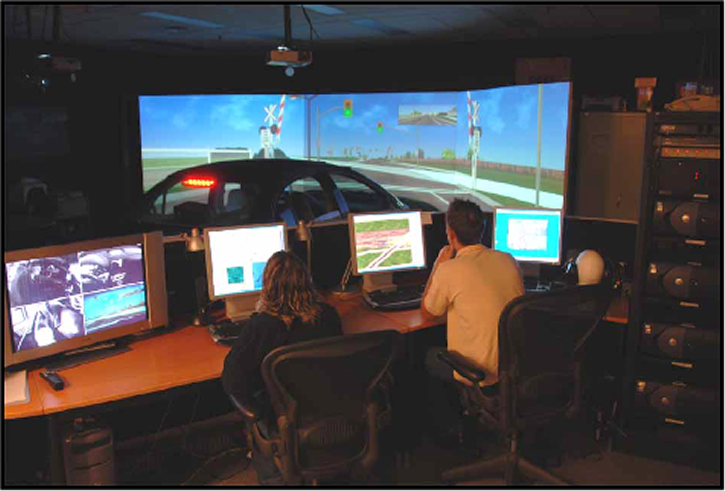 The CERL lab — where it all started.
The research
The world was just beginning to change
I grew up with one landline in the kitchen. Three TV channels. Cassette tapes. Walkmans. Fax machines. When I took Human Factors 101, email was still a novelty. Technology was beginning to reshape daily life — but we were early enough to see the seams. Early enough to ask what it was doing to us.
In the lab I studied how mobile phones — even basic ones — changed behaviour behind the wheel. Not in obvious ways, but in quieter ones: how attention shifted, how decisions changed, how people overestimated their ability to manage both. That was the first time I understood that the danger isn’t always the thing you can see coming. Sometimes it’s the slow drift you don’t notice until you’re already somewhere you didn’t intend to be.
Technology changes behaviour faster than we realise. And humans adapt — in unintended and sometimes dangerous ways.”
Graduate school
Finding the question that would follow me everywhere
My mom drove me across the border and across the country to the University of Iowa. She helped me open a bank account and find my first apartment, then drove back home to Canada alone. I started my Masters, finished in a year and a half, and stayed for my PhD.
My focus was collision warning systems — early, inconsistent technology that gave off what felt like random alerts. I studied what happened when people couldn’t fully trust a system. They’d rely on it when it worked, then fail to act in the moments it mattered most. Or they’d give up on it entirely and lose the real benefits.
The goal wasn’t maximising trust. It was calibrating it — understanding enough about how a system works, and where it fails, to navigate it well. That’s not just a research finding. It turned out to be a compass for everything that came after.
The first leap
From the lab to Google — and learning to trust the jump
By the time I was finishing my dissertation, the light had gone out a little. I was dragging. My advisor had gone on sabbatical. I’d been at it for years. And then an ad appeared in the HFES bulletin for an internship at Google. My mom convinced me to apply. I did.
After several stressful rounds of interviews, they offered me the position. I quit smoking. My husband and I — both still finishing our PhDs — packed everything into our car and drove from Iowa City to San Francisco with no plan beyond the next few months. We just took the leap.
I arrived and found out I was working on the autonomous vehicle project at Google X. The same patterns I’d studied in my dissertation were playing out in real time — at a scale and speed I hadn’t imagined. A mentor said something I needed to hear:
It doesn’t have to be perfect to be useful. I’ve been trying to hold onto that ever since.”
The arc
The industries changed. The question didn’t.
I spent the next decade asking the same question in different rooms. The work shifted — from autonomous vehicles to YouTube to navigation to travel to global content systems — but the thread was always the same: how do humans interact with complex systems? Where does it break down? And what would it look like if it actually worked?
Then a call that looked like a phishing email changed everything. It was from Agoda — a fast-growing travel platform in Bangkok. We debated it for months. My husband thought I would make more money. I did not. In the end we committed fully. We sold the house. Sold the cars. My husband quit his job. We packed up our two and four year old and flew across the world with no plan beyond landing. Bangkok became home in a way neither of us planned. It has been the best move we have ever made.
Some bets aren’t really about the money. They’re about the life on the other side of the leap.”
-
PhD · Iowa
Calibrated trust in unreliable collision warning systems -
Google X
Autonomous vehicles — the same dissertation patterns, at real scale -
YouTube
Personalization, content discovery — research as strategy, not validation -
Google Maps
Navigation for real people — walking, driving, motorcycling across countries -
Agoda
Building product insights in a fast-growing travel platform in Bangkok -
Electrolux
Human Factors applied to organisations — 150+ domains, APAC and Europe
It turned out I was still studying how humans interact with complex systems. The system had just changed from a car or a product to an organisation itself.”
The hard part
My body gave out before I did
At Agoda, COVID hit while I was trying to lead a team and raise two kids from a kitchen table. Several reorgs. Reduced budgets. Working from home with kids doing school beside me. I was trying to be a good leader and a good parent at the same time — and I had failed to put my own oxygen mask on first.
My body gave out before I did. It was the first time I really listened to it. I stepped back, slowly focused on my health, and started to ask honestly what I actually wanted next. I realized that you need to hold strong and stay true — to what you know, to why it matters, to your values and who you are. That’s not a small thing to learn. It cost me a lot to get there.
After a year off I joined Electrolux. On paper it looked like a different kind of work. In practice the questions were identical. And I learned something new: I like building things, not just understanding them. Dam and Flow is that next thing.
Why I’m writing now
A question that slowly became a different question
My mom died last year. She knew it was coming — two years of COPD, her life no longer being what it was. In those two years she became incredibly intentional: choosing what to keep, what to let go, repairing relationships, reducing the clutter that no one else would value. She wanted to live with dignity. And she did.
Her death made me realise that I have not been.
The question I started with was always: how do we make this better? Over the years it slowly became: how do we grow the business? The drift was gradual. I barely noticed it happening. Part of that was personal. Part of it was structural.
Human Factors merged with cognitive psychology and then with behavioural economics — researchers like Kahneman and Ariely revealing just how predictably irrational human decision-making is, and how reliably it can be shaped by design. That sophistication was increasingly deployed in the hands of businesses whose measure of success was growth — not safety, not wellbeing, not the original question the field was built to answer. The knowledge kept expanding. The guardrails did not keep pace.
My kids have devices now. I watch them navigate systems designed to capture attention, not protect it. And I see myself in them — I still find myself scrolling when I meant to check just one thing. I helped build some of these systems. I know exactly how they work. And I still end up somewhere I didn’t intend to be.
That’s not a personal failing. It’s a design problem. And learning to recognise it — to name it, understand it, and find your way back — is what this blog is about. Not alarm. Not restriction. Finding the compass. The kind that comes from understanding how these systems work, what they’re designed to do, and what we want instead.
My mom spent her last two years choosing what to keep. That feels like exactly the right place to start.